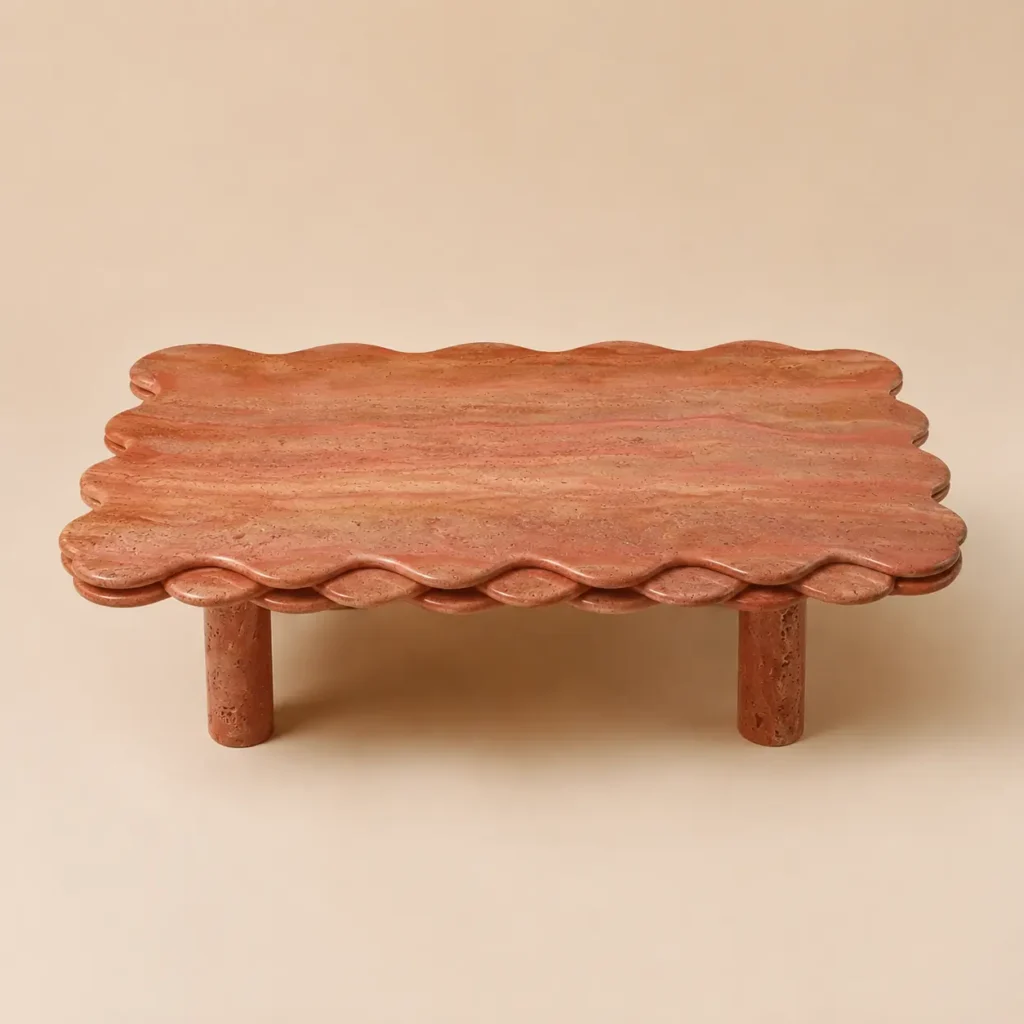
What is a red travertine center table? A red travertine center table is a low, sculptural coffee table carved from a single type of natural travertine stone that carries warm red, terracotta, and rust tones with the characteristic pitted, fibrous texture unique to travertine. This particular design features a rectangular tabletop with a hand-carved scalloped, wave-like edge and two solid cylindrical legs, all cut and finished from the same red travertine block family so the color and veining stay consistent across the piece. Pakistan Marble & Onyx sources the raw travertine block, then saws, shapes, fills, and polishes each table by hand in its own workshop.
What makes travertine different from marble or onyx? Travertine is a sedimentary stone formed by mineral deposits from hot or cold spring water, which gives it a naturally porous, pitted surface with small holes and channels running through the stone, a texture true marble and onyx don’t have. Marble is a metamorphic stone with smooth veining, while onyx is a translucent, tightly banded calcite. Travertine’s natural holes are typically filled with a matching resin or grout compound during finishing to create a smooth, usable surface while still showing the stone’s organic texture.
Is this table durable enough for daily coffee table use? Yes. Once finished, filled, and sealed, a travertine coffee table is fully suitable for everyday living room use; it is slightly softer than granite but comparable in durability to marble, and its main care requirement is avoiding prolonged contact with acidic liquids and re-sealing periodically to protect the filled surface.
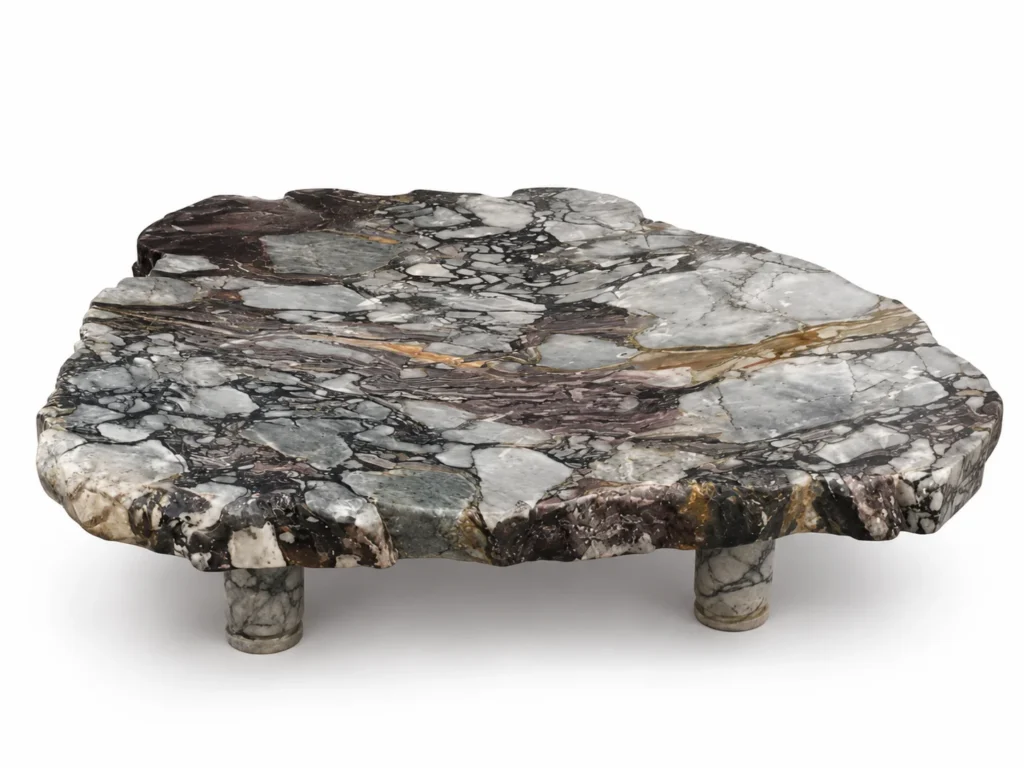
Red Travertine Center Table: Handcrafted Sculptural Coffee Table from Pakistan Marble & Onyx
Some pieces of furniture are built to disappear into a room. This is not one of them. The Red Travertine Center Table is a low, wide, sculptural coffee table carved from a single family of natural red travertine, with a hand-shaped scalloped edge that runs the entire perimeter of the tabletop like a ribbon folded in stone, sitting on two solid cylindrical legs cut from the same block. It is the kind of piece that a room gets built around, not the kind that gets tucked into a corner.
As a Pakistan based marble supplier and stone furniture manufacturer, Pakistan Marble & Onyx sources raw travertine directly from quarry partners, then saws, shapes, hand-carves, fills, and polishes every table in our own workshop. That means the piece you’re looking at was never handled by three layers of importers before reaching you, it was cut, carved, and finished by the people who run the machines and hold the polishing tools.
This page walks through everything worth knowing before you buy: what red travertine actually is, how a piece like this is made from raw block to finished table, how it compares to marble and onyx, how to care for it long-term, and answers to the questions we hear most often from customers, written so you get a clear, direct answer whether you’re reading this page or seeing it summarized in a search result.
4. What Makes This Table Different
The Scalloped Edge Is Carved, Not Molded
The wave-like, scalloped edge running around the tabletop is shaped by hand using diamond grinding tools and finished with progressively finer polishing pads. This is a slow, deliberate carving process, each scallop has to be shaped individually and blended smoothly into the next so the wave pattern reads as continuous rather than segmented. It is not a poured, cast, or composite material pressed into a mold; every curve is removed material, cut directly from solid stone.
Natural Red Travertine, Not Dyed Stone
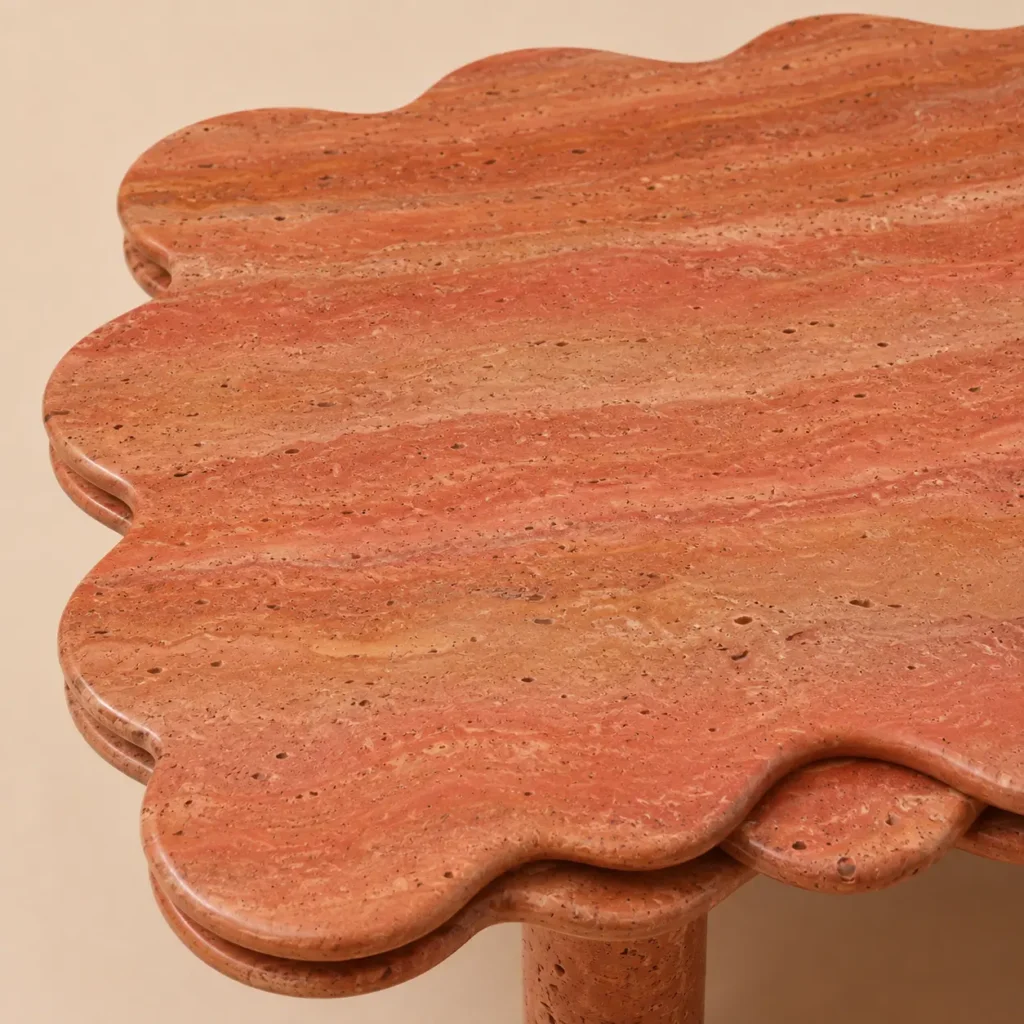
The warm red, rust, and terracotta tones running through the tabletop are the stone’s natural mineral coloring, produced by iron oxide content in the original mineral deposit. Genuine red travertine carries color variation and directional banding that reads as movement across the surface, lighter cream-orange striations running through deeper rust bands, rather than a flat, uniform red.
Filled and Sealed for Everyday Use
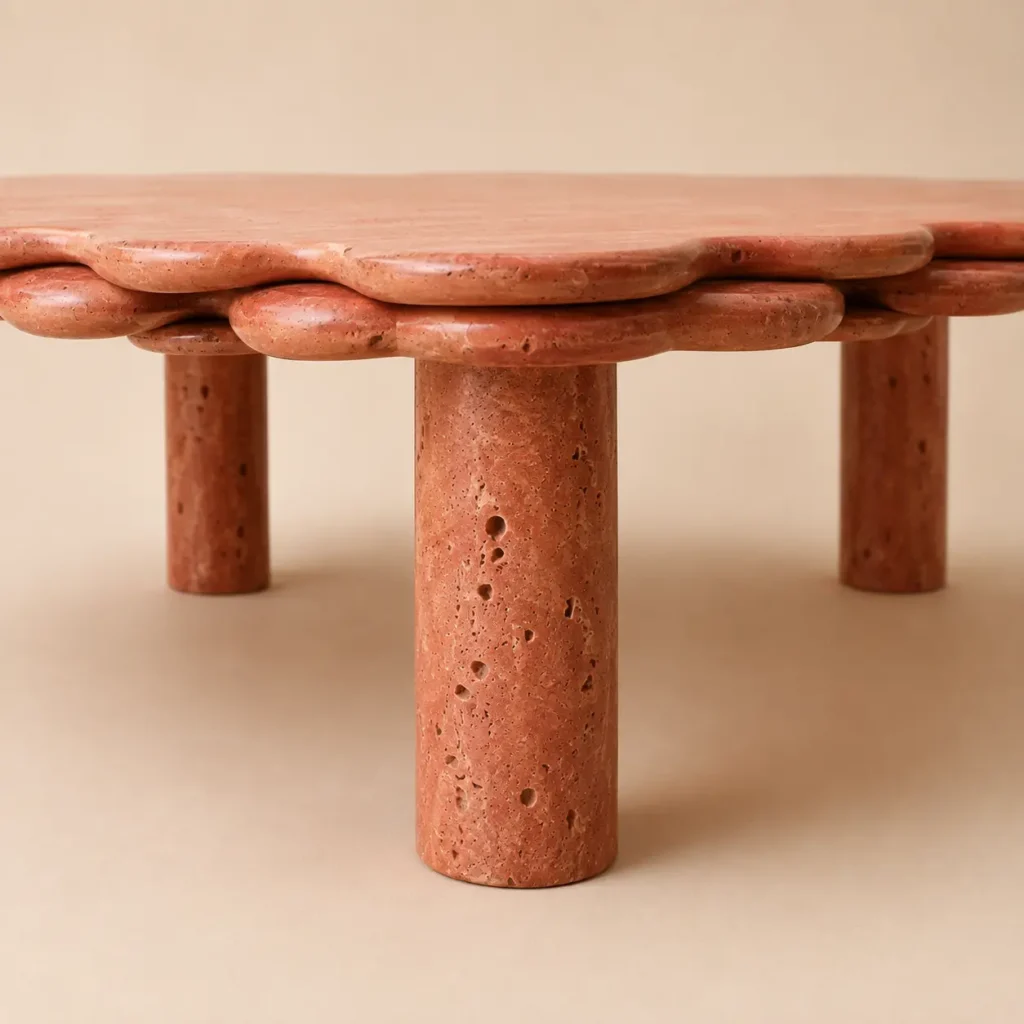
Travertine’s defining characteristic is its natural porosity: as the stone forms, gas bubbles and mineral channels leave small holes and pits throughout the material. On a finished furniture piece, these are filled with a matching resin or cement-based filler and then polished flush, giving a smooth, closed surface that still shows the organic texture and occasional small unfilled pockets that are part of travertine’s natural character, not a manufacturing flaw.
Solid Stone Legs, Not Applied Feet
The two cylindrical legs are solid, load-bearing stone columns cut and finished from the same travertine family as the top, not a separate wood or metal base with a stone top attached. This is part of why the finished table carries real weight and a grounded, substantial feel when it’s placed in a room.
A Statement Piece, Not a Filler Piece
Given its low profile, wide scalloped surface, and sculptural leg placement, this table is designed to function as the visual anchor of a seating area, the kind of piece that determines the rest of a room’s material and color choices, rather than one that’s chosen last to match everything else.
5. About Red Travertine: The Stone Itself
What Travertine Actually Is
Travertine is a form of limestone deposited by mineral springs, particularly hot springs, as dissolved calcium carbonate precipitates out of the water and builds up in layers over time. This is a faster geological process than the deep, slow-forming deposits that create marble, which is one reason travertine typically shows a more fibrous, layered, and pitted texture rather than marble’s smoother, more continuous veining.
Why It’s Called “Red” Travertine
Travertine’s base color depends heavily on the mineral content of the water and surrounding rock at the deposit site. Iron oxide presence produces the warm red, rust, and terracotta tones seen in red travertine, in the same way iron oxide is responsible for red and orange tones in many other iron-rich stones and soils. Travertine is graded and named largely by this dominant color family: ivory/beige (the most common, widely used in flooring and cladding), walnut/noce (deep brown), gold, and red, with red travertine being one of the rarer and more visually dramatic categories, typically reserved for statement furniture and accent pieces rather than large-format flooring.
The Natural Holes Are a Feature, Not a Defect
Unlike marble or onyx, travertine’s defining visual trait is its network of small natural holes, channels, and pits, formed by trapped gas bubbles and organic material during the stone’s rapid deposition. Depending on the finish, these are either:
- Filled: holes are filled with resin or cement-based filler and polished flush, producing a smoother, closed surface (the standard approach for furniture and countertops), or
- Unfilled/honed: holes are left open for a more raw, textural surface (more common in flooring and wall cladding, less common in furniture meant for daily contact).
For a coffee table like this one, a filled finish is almost always used so the surface stays smooth and easy to clean while still visibly carrying travertine’s characteristic texture.
Hardness and Durability
Travertine sits at roughly 3 to 4 on the Mohs hardness scale, similar to marble and somewhat softer than granite or quartzite. It can be scratched by very hard or sharp objects and can etch when exposed to strongly acidic substances (vinegar, citrus juice, some cleaning products) for extended periods. For coffee table use, where the surface mostly holds books, trays, drinks with coasters, and décor objects rather than direct food prep, this level of hardness is entirely appropriate and is the same durability profile as most natural stone furniture in this category.
Why Red Travertine Costs More Than Standard Travertine
Ivory and beige travertine are the most abundant and widely quarried colorways, which keeps their pricing comparatively accessible. Red travertine deposits are rarer, and matching color and banding consistently across a single large tabletop, as required for a piece like this, takes more careful block selection and cutting than smaller-format uses like tile. This scarcity and selection process is reflected in the higher price point of red travertine furniture compared to standard-color travertine tile or slabs.
6. Where This Travertine Comes From
Pakistan is home to significant natural stone reserves across Punjab, Khyber Pakhtunkhwa, and Balochistan, producing marble, onyx, and travertine that are exported to markets across the Middle East, Europe, North America, and East Asia. As a Pakistan marble supplier and stone manufacturer, Pakistan Marble & Onyx works directly with quarry partners across these regions to source travertine blocks suited to furniture-scale cutting, meaning large enough, and consistent enough in color, to produce a single unbroken tabletop rather than pieced-together sections.
Working directly with quarry sources matters for three reasons that carry through to the finished piece you receive:
- Color and banding consistency: because a tabletop this size needs to be cut from a single block or closely matched blocks, direct quarry access lets us select stone specifically suited to large-format furniture rather than settling for offcuts.
- Realistic lead times: for trade, hospitality, and custom furniture orders, a direct quarry relationship provides more reliable visibility into upcoming block availability than buying through resellers.
- Price: removing import layers keeps pricing more competitive for both individual buyers and bulk/trade clients sourcing multiple pieces.
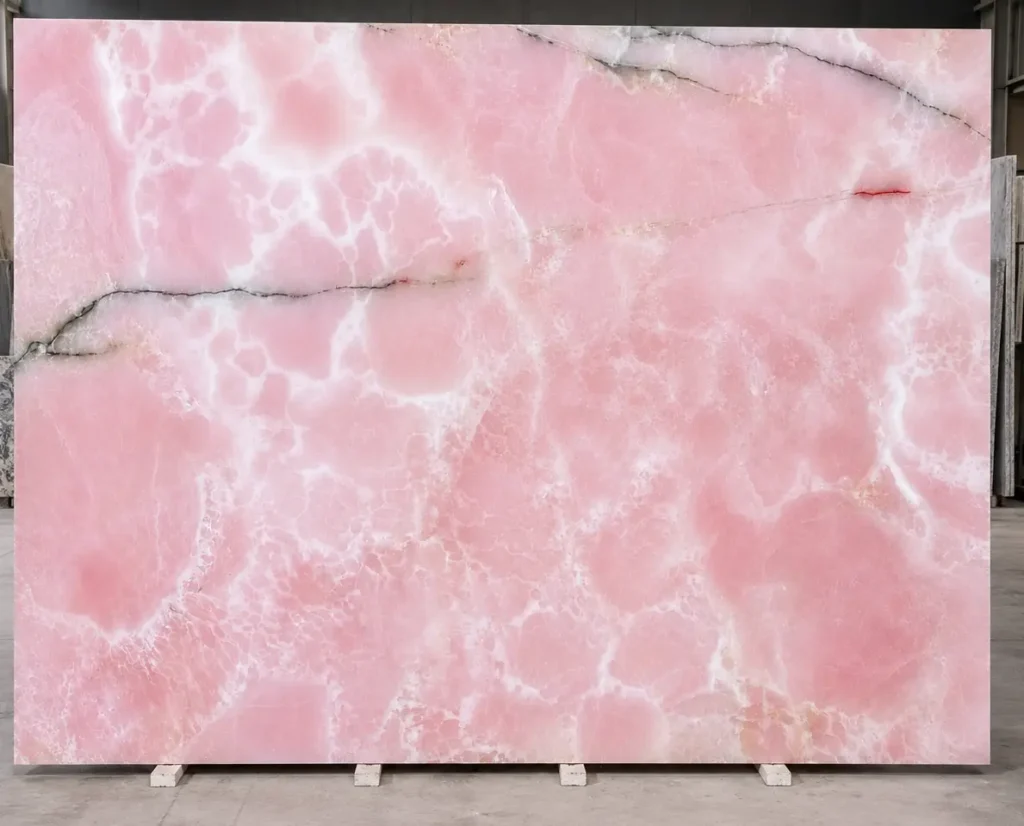
7. How the Table Is Made: From Block to Finished Piece
Step 1: Block Selection
Raw travertine blocks are inspected for color depth, banding direction, and the extent of natural fissuring before being set aside specifically for furniture-scale cutting. A block destined for a center table like this one needs enough consistent, unbroken material to produce a full tabletop slab plus two matching legs from the same color family.
Step 2: Slab Cutting
The block is cut into a rough tabletop slab and two cylindrical leg blanks using diamond-tipped saws, sized generously to allow for the scalloped edge to be carved from the slab’s outer perimeter without running out of material.
Step 3: Rough Shaping of the Scalloped Edge
The wave-like scalloped profile is roughed out around the tabletop’s perimeter using diamond grinding wheels, working section by section to establish the rhythm and spacing of the scallops before any fine detailing begins.
Step 4: Hand-Carving and Blending
Each scallop is refined and blended into its neighbors by hand, since travertine’s natural fissures and hole clusters can vary in density across a single slab, meaning a rushed or purely mechanical pass can leave visible seams between adjacent scallops.
Step 5: Filling Natural Holes
The tabletop and legs are filled with a color-matched resin or cement-based filler to close the stone’s natural pores and holes, producing a smoother, more practical surface for daily coffee table use while preserving the visible texture that makes travertine recognizable.
Step 6: Leg Turning and Fitting
The two cylindrical legs are shaped on a lathe and fitted to the underside of the tabletop, with the joint reinforced to support the weight and footprint of the slab above.
Step 7: Multi-Stage Polishing
The entire piece (top, scalloped edge, and legs) is polished through a sequence of increasingly fine abrasive grits, finishing with a compound that brings out the stone’s natural gloss and evens out the color depth across the filled and unfilled sections.
Step 8: Quality Inspection
Each table is checked under direct light for consistency of fill, polish evenness across the scalloped edge, and structural stability of the leg joints before being cleared for packaging.
Step 9: Packing for Shipping
Given the weight and fragility of a large stone tabletop, tables are crated with reinforced protection focused on the scalloped edge (the most vulnerable point for chipping) and the leg-to-top joints, for both domestic delivery and international export.
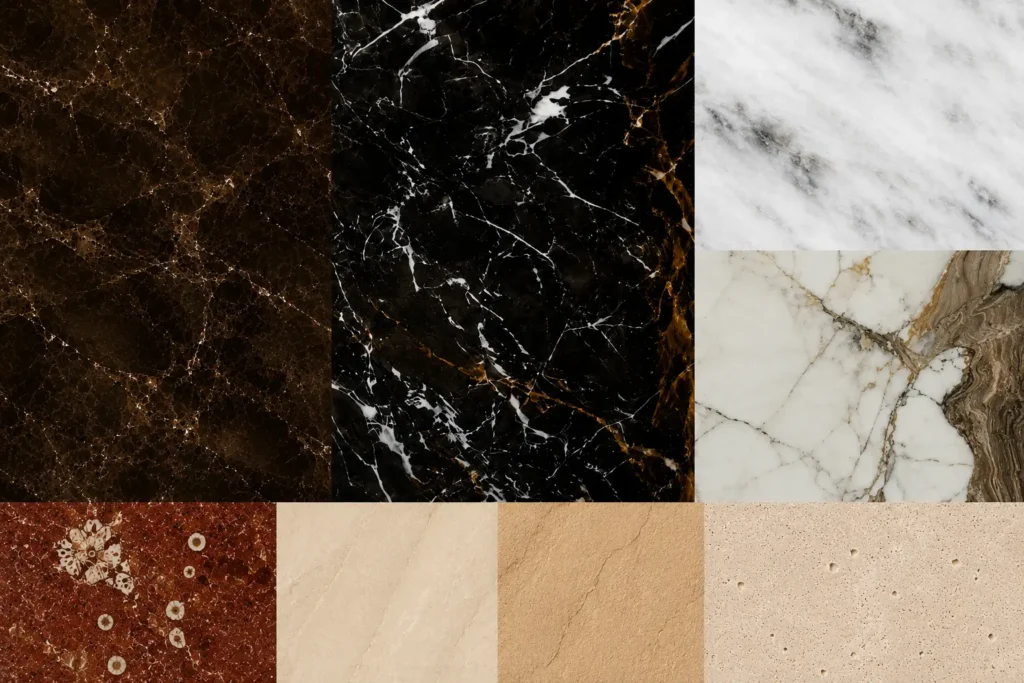
8. Red Travertine vs. Other Materials
Travertine vs. Marble
Marble is a metamorphic stone with smooth, continuous veining and no natural holes; travertine is a sedimentary stone with a pitted, fibrous texture that is filled during finishing. Marble is slightly harder on average, while travertine’s textured surface gives it a more organic, tactile visual character that many designers specifically choose over marble’s smoother finish for furniture with strong sculptural forms.
Travertine vs. Onyx
Onyx is translucent and shows concentric or wavy banding that can transmit light; travertine is opaque and shows a fibrous, pitted texture with directional color banding rather than glowing translucency. Onyx is typically chosen for backlit or light-catching decorative pieces, while travertine is more commonly chosen for furniture, flooring, and architectural surfaces where texture and warmth matter more than light transmission.
Filled Travertine vs. Unfilled/Honed Travertine
Filled travertine has a smoother, closed surface better suited to furniture and countertops that see daily contact; unfilled or honed travertine keeps the open pore structure visible and is more common in flooring, wall cladding, and outdoor applications where a raw, matte texture is the design goal.
Red Travertine vs. Ivory/Beige Travertine
Ivory and beige travertine are more widely available and commonly used in large-format flooring and cladding projects; red travertine is rarer, shows more dramatic iron-oxide coloring, and is generally reserved for standout furniture and accent pieces rather than large architectural surfaces.
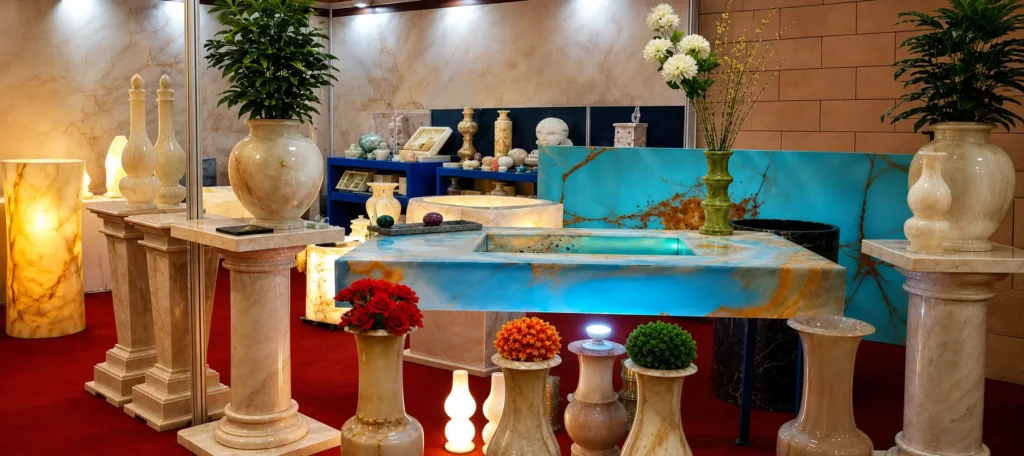
9. Suggested Uses for the Red Travertine Center Table
- Living room coffee table: its low profile and wide surface make it a natural centerpiece for a sofa-and-armchair seating arrangement
- Sculptural entryway table: used against a wall as a console-height display surface for décor objects, trays, or a single sculptural vase
- Hospitality lounge and lobby furniture: hotels, boutique retail spaces, and restaurant lounges use statement stone tables like this as anchor pieces in seating areas
- Gallery and showroom display base: the wide, textured surface works well as a plinth-style display base for art objects, ceramics, or retail merchandising
- Photography and styling backdrop: the scalloped edge and warm red tone photograph distinctively, making it a popular choice for editorial and product photography setups
- Boutique office or reception seating area: a low, sculptural table like this reads as a design statement in reception and waiting areas for design-forward businesses
10. Care and Maintenance
Proper care will keep the color depth, fill integrity, and polish of a red travertine table looking new for years:
- Wipe up spills promptly. Filled travertine is more water- and stain-resistant than unfilled stone, but standing liquids, especially wine, coffee, and acidic drinks, should still be wiped up rather than left to sit.
- Clean with a soft cloth and pH-neutral soap. Avoid abrasive scrubbers, steel wool, or anything that could wear down the polished surface or dislodge the resin fill.
- Avoid acidic and abrasive cleaners. Skip vinegar-based cleaners, bleach, and citrus-based products, since these can etch the stone’s surface and degrade the filler material over time.
- Use coasters and trays for daily items. While the table is fully suitable for everyday use, coasters under glasses and trays under frequently moved objects help protect the polished finish from ring marks and small scratches.
- Reseal periodically. A quality stone sealant applied roughly every 12 months (more often in high-traffic households) helps maintain the surface’s water resistance and protects the filled areas from re-opening or staining.
- Avoid dragging heavy objects across the surface. Lift rather than slide décor items, trays, or books to avoid fine scratching on the polished top.
- Support the legs on a stable, level floor. Because the legs are solid stone and bear the full weight of the tabletop, an uneven floor surface can create uneven stress on the leg-to-top joints over time.
- Dust regularly with a dry or slightly damp microfiber cloth to prevent grit buildup in the scalloped edge detailing, where dust and debris can accumulate in the carved grooves.
11. Why Buy From Pakistan Marble & Onyx
Direct manufacturer, not a reseller. We cut, carve, and polish travertine, marble, and onyx in our own workshops using stone sourced directly from Pakistani quarry partners, giving us tighter quality control and more competitive pricing than buying through import intermediaries.
Furniture-scale block sourcing. Large single-piece furniture like this center table requires blocks selected specifically for size and color consistency, a different sourcing standard than tile or small décor pieces, and our direct quarry relationships give us better access to blocks that meet that bar.
Trade and hospitality experience. We regularly supply interior designers, hotel groups, restaurant and retail buyers, and export clients, and can accommodate custom sizing, finish requests, and bulk orders for trade projects.
Transparency on finish type. We’re upfront about whether a piece is filled or unfilled travertine, since this materially affects maintenance expectations, and we don’t market composite or reconstituted stone as genuine natural travertine.
Export packaging experience. Large stone furniture is one of the more demanding categories to ship safely, we crate and pack specifically to protect vulnerable points like carved edges and leg joints across long-distance domestic and international freight.
Direct quarry access across Pakistan’s marble and stone regions: giving us clearer visibility into block availability, color families, and realistic lead times for both individual and trade buyers.
What is a red travertine center table? A red travertine center table is a low, sculptural coffee table carved from a single type of natural travertine stone that carries warm red, terracotta, and rust tones with the characteristic pitted, fibrous texture unique to travertine. This particular design features a rectangular tabletop with a hand-carved scalloped, wave-like edge and two solid cylindrical legs, all cut and finished from the same red travertine block family so the color and veining stay consistent across the piece. Pakistan Marble & Onyx sources the raw travertine block, then saws, shapes, fills, and polishes each table by hand in its own workshop.
What makes travertine different from marble or onyx? Travertine is a sedimentary stone formed by mineral deposits from hot or cold spring water, which gives it a naturally porous, pitted surface with small holes and channels running through the stone, a texture true marble and onyx don’t have. Marble is a metamorphic stone with smooth veining, while onyx is a translucent, tightly banded calcite. Travertine’s natural holes are typically filled with a matching resin or grout compound during finishing to create a smooth, usable surface while still showing the stone’s organic texture.
Is this table durable enough for daily coffee table use? Yes. Once finished, filled, and sealed, a travertine coffee table is fully suitable for everyday living room use; it is slightly softer than granite but comparable in durability to marble, and its main care requirement is avoiding prolonged contact with acidic liquids and re-sealing periodically to protect the filled surface.
13. A Buyer’s Guide to Choosing the Right Stone Center Table
If you’re comparing center table options across materials or colors, here’s a practical framework we walk trade and retail customers through:
1. Decide the visual role of the piece first. A table meant to be the visual anchor of a room, like this scalloped red travertine design, benefits from a bold silhouette and strong color; a table meant to blend into an existing scheme may call for a quieter beige or ivory travertine instead.
2. Match the stone’s warmth to your existing palette. Red travertine pairs naturally with warm wood tones, terracotta and rust textiles, brass hardware, and earth-toned upholstery. Cooler beige or gray-veined marble suits more neutral, minimalist palettes better than red travertine’s warm iron-oxide tones.
3. Consider room scale and proportion. A wide, low table like this works best with generously sized seating and enough surrounding floor space for the scalloped edge to read clearly, rather than being crowded against furniture on all sides.
4. Ask about the fill type before ordering. Confirm whether the piece is fully filled and polished (best for everyday coffee table use) or left more raw/honed (a more textural, lower-maintenance-looking finish, but less practical for frequent spills).
5. For trade and hospitality orders, request block-matched sets. If you need multiple tables or coordinating pieces with a visually cohesive look, ask specifically for pieces cut from the same or adjacent travertine blocks, since color and banding can shift meaningfully between different blocks even within the same “red travertine” category.
6. Confirm floor load and delivery access early. Because solid stone furniture is considerably heavier than wood or composite pieces, confirm doorway, staircase, and floor-load considerations with your delivery team before the piece ships, particularly for upper-floor or narrow-access installations.
14. Red Travertine Center Table: Quick Comparison Table
| Feature | Red Travertine | Ivory/Beige Travertine | Marble Center Table | Onyx Accent Table | Wood Coffee Table |
|---|---|---|---|---|---|
| Natural material | Yes | Yes | Yes | Yes | Yes (if solid wood) |
| Surface texture | Pitted, filled | Pitted, filled | Smooth veining | Smooth, translucent | Smooth, grained |
| Translucent | No | No | No | Yes | No |
| Unique per piece | Yes | Yes | Yes | Yes | Varies |
| Typical hardness (Mohs) | ~3-4 | ~3-4 | ~3-4 | ~3 | N/A (material differs) |
| Best for daily coffee table use | Yes (filled/sealed) | Yes (filled/sealed) | Yes | Limited (better as accent) | Yes |
| Relative price point | Higher (rarer color) | Moderate | Higher | Higher | Lower to Moderate |
| Needs periodic sealing | Yes | Yes | Yes | Yes | No |
15. Glossary: Understanding Travertine Terminology
Travertine: A sedimentary form of limestone deposited by mineral spring water, known for its layered, fibrous texture and natural pitting.
Filled travertine: Travertine finished by filling its natural holes with a color-matched resin or cement compound, then polishing smooth for furniture, countertop, and flooring use.
Unfilled/honed travertine: Travertine finished with its natural pore structure left open, giving a more raw, matte, textural surface, generally used for flooring, cladding, and outdoor applications.
Banding: The directional color layering visible in travertine and other sedimentary/metamorphic stones, formed by successive mineral deposits over time.
Iron oxide coloring: The mineral compound responsible for the red, rust, and orange tones found in red travertine and other iron-rich natural stones.
Etching: Dulling or discoloration of a polished stone surface caused by contact with acidic substances.
Block-matched: A set of pieces cut from the same or adjacent raw stone block, ensuring closely related color and banding across multiple items.
Sealing: Applying a penetrating stone sealant to reduce porosity and protect against staining, etching, and moisture damage.
16. Styling Ideas: Where to Place a Red Travertine Center Table
Living room seating area: Positioned between a sofa and one or two accent chairs, the wide scalloped top gives enough surface for drinks, a stack of books, and a tray, while the low profile keeps sightlines open across the room.
Warm, earth-toned interiors: The table’s red-rust coloring is a natural fit for interiors already leaning into terracotta, clay, rust, and warm neutral palettes, where it reinforces rather than competes with the existing color story.
Contrast against cool, minimalist spaces: In a room built around whites, grays, and cool woods, this table works as a deliberate warm-toned focal point rather than a blended piece, a common styling choice for designers wanting one clear statement object per room.
Boutique hotel lobbies and lounges: The scale and sculptural form suit hospitality lounge seating areas, where a single striking table often does more visual work than an entire seating group of smaller furniture.
Layered with textiles and ceramics: A woven tray, a stack of linen-bound books, and one or two ceramic or glass objects on top tend to let the stone’s texture and edge detailing remain the visual focus rather than competing with busy patterns.
17. About Pakistan Marble & Onyx
Pakistan Marble & Onyx operates as both a marble supplier and a natural stone furniture manufacturer: handling the full chain from raw block sourcing through to finished, ready-to-ship furniture and décor pieces. Our workshops process marble, onyx, and travertine, and furniture-scale pieces like this center table represent some of our most technically demanding work, since they require larger, more consistent blocks than smaller décor items and significantly more hand-carving time for detailed edge work.
We work with three broad categories of buyers:
Retail and individual customers purchasing single statement furniture pieces for their own homes.
Interior designers and architects sourcing one-off or small-batch furniture for residential and commercial projects, often with specific color-matching, sizing, or edge-detailing requirements tied to a broader design scheme.
Trade, hospitality, and export buyers, including hotel groups, restaurant and retail chains, and international importers, placing custom or bulk furniture orders that require consistent quality control, reinforced packaging, and reliable freight documentation for cross-border shipping.
Across all three categories, our approach stays the same: source genuine stone directly from Pakistani quarry partners, carve and finish it by hand in our own workshop, and communicate clearly about finish type, realistic lead times, and pricing, rather than overselling a level of uniformity that natural stone furniture at this scale simply can’t guarantee.
A Note on Photography and Natural Variation
Every product photo on our site is of an actual piece we have produced, not a rendered or stock image. Because travertine is entirely natural, the exact table shown may already be sold by the time you order; in that case, you’ll receive a piece from the same color family and block group, and we’re happy to send current photos before your order ships if an exact match matters to you.
Every red travertine center table leaving our workshop has already gone through block selection, slab cutting, hand-carving of the scalloped edge, filling, leg turning, multi-stage polishing, and a final quality inspection before it’s packed for shipping. Because the stone is completely natural, what you’re really buying isn’t just a coffee table, it’s a cross-section of a mineral deposit that took thousands of years to form, shaped by hand in Pakistan and shipped directly from the source.
If you’re a designer, hospitality buyer, or retailer looking to source red travertine furniture or other natural stone pieces in volume, reach out to Pakistan Marble & Onyx directly for current block availability, trade pricing, and lead times.
Is this table made from real natural travertine, or is it a composite/reconstituted stone?
This table is cut and carved from genuine natural red travertine sourced from Pakistani quarries. The red and rust tones are the stone’s natural iron-oxide coloring, not dye or paint. We clearly label any composite or reconstituted stone products separately and do not market them as natural travertine.
Are the small holes in the stone a defect?
No. Natural holes and pitting are a defining characteristic of travertine, formed as the stone deposits from mineral spring water. On this table, the surface is filled with a color-matched resin or cement compound and polished smooth, so you’ll see the texture but the surface itself is closed and practical for daily use.
Can I use this as an everyday coffee table, or is it purely decorative?
It’s fully suitable for everyday coffee table use, holding trays, books, drinks with coasters, and décor objects. Like any natural stone furniture, it’s not designed to withstand direct cutting, extreme heat, or prolonged acidic spills without cleanup.
How do I clean and maintain a red travertine table?
Wipe with a soft cloth and pH-neutral soap, avoid acidic or abrasive cleaners, and use coasters for daily glassware. Reseal roughly every 12 months to maintain water resistance and protect the filled surface.
Why does the color vary from the photos?
Because travertine is a natural stone, color depth, banding, and hole density vary from block to block. The photos represent the general color family and edge-carving style; if you need visual confirmation of the specific piece before it ships, contact us for current photos.
What’s the difference between red travertine and standard beige/ivory travertine?
Red travertine carries stronger iron-oxide coloring and is rarer than the more commonly quarried ivory and beige varieties, which is why it’s typically reserved for statement furniture pieces rather than large-scale flooring projects. Beige and ivory travertine remain more common and generally more budget-accessible.
Do you sell wholesale or to trade/hospitality buyers?
Yes. As a Pakistan-based marble and stone manufacturer, we regularly work with interior designers, hotels, restaurants, and international importers on custom and bulk furniture orders. Contact us directly for trade pricing and lead times.
Can you customize the size, edge style, or leg design of this table?
Custom dimensions, edge detailing, and leg configurations can often be arranged for individual custom orders or bulk trade orders since we control our own cutting and carving process. Reach out with your specifications and we’ll confirm feasibility and lead time.
How is the table packaged and shipped, especially for international orders?
Given the weight and fragility of natural stone furniture, each table is crated with reinforced protection focused on the carved edge and leg joints, which are the most vulnerable points during transit. We have experience packing and exporting large stone furniture pieces internationally.
How much does a table like this weigh, and does it need special floor or furniture support?
Solid stone furniture is significantly heavier than wood or composite furniture of similar size; exact weight varies by final dimensions. We recommend confirming that your flooring and any supporting surfaces can handle the load, especially for upper-floor installations, and can provide approximate weight specifications on request.
What’s the difference between this table and a marble center table?
Marble shows smooth, continuous veining and has no natural holes, while this travertine table shows a pitted, fibrous texture (filled smooth) with warm red-rust coloring driven by iron oxide. Both are genuine natural stone, but travertine’s texture and travertine’s typically warmer color families give it a more organic, tactile visual character compared to marble’s smoother, often cooler-toned veining.
Does the table come with a care guide or warranty?
A basic care guide is included with every order. As with all natural stone furniture, normal wear from misuse (heavy impact, prolonged acid exposure, etc.) is not covered, but manufacturing defects are.
Where does the red travertine for this table come from?
Our travertine is sourced from quarry partners across Pakistan’s stone-producing regions, selected specifically for the color consistency and block size required for large single-piece furniture like this center table.
Can this table be used outdoors?
We don’t recommend prolonged outdoor use for the filled, polished finish, as direct sun exposure, rain, and temperature swings can affect the filler material and stress natural fissures in the stone over time. It’s best suited to indoor use.
How long does shipping take?
Domestic delivery and international export timelines vary by destination, order size, and whether custom crating is required for large furniture. Contact us directly with your location for an accurate estimate.
Will the scalloped edge chip easily?
The carved edge is solid stone and holds up well under normal handling, but like any carved natural stone detail, it’s more vulnerable to chipping from sharp direct impacts than a flat, unshaped edge, which is why we reinforce packaging specifically around the edge profile during shipping.
Can I get matching side tables or accent pieces in the same red travertine?
Where block availability allows, we can produce coordinating side tables, stools, or accent pieces cut from the same or closely matched travertine blocks for a cohesive set, worth requesting directly if you’re building a coordinated room rather than a single piece.