Irani Blue Onyx: 7 Breathtaking Reasons This Rare Charcoal-Gold Stone Is Redefining Luxury Interiors
Some stones decorate a room. Irani Blue Onyx commands it.
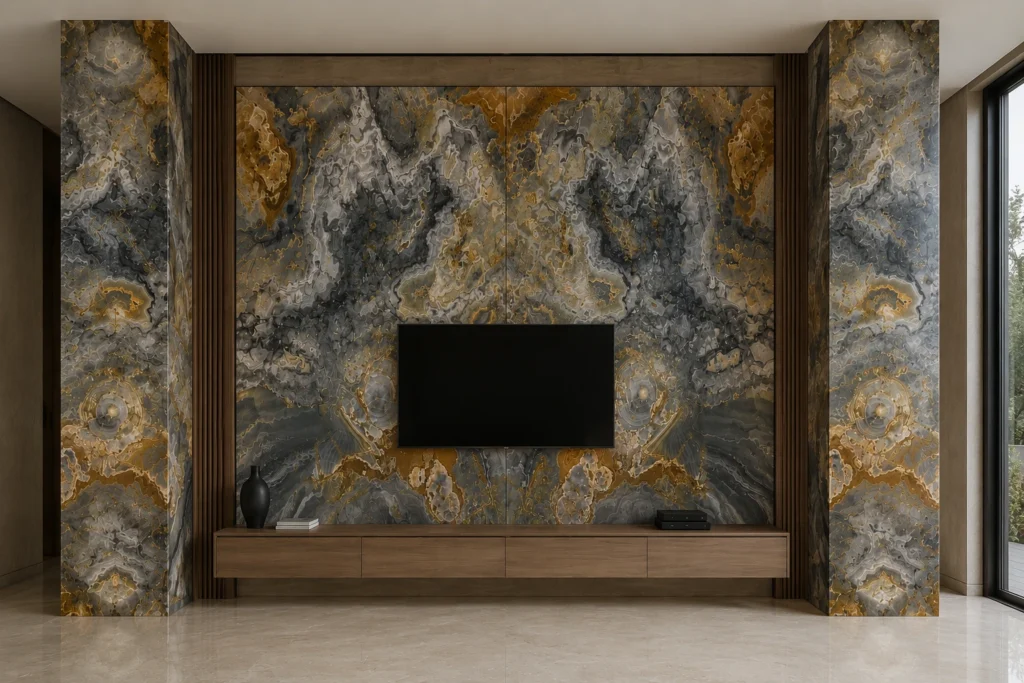
If you’ve ever seen a slab of natural stone that looks less like building material and more like a frozen storm charcoal-grey clouds fractured by rivers of molten gold, with strange, glowing geode-like circles trapped inside the surface you’ve seen Irani Blue Onyx, and you understand why architects and hoteliers stop scrolling the moment it appears in their feed.
At Pakistan Marble & Onyx, we source, cut, polish, and export premium Irani Blue Onyx directly to architects, interior designers, hoteliers, contractors, and stone distributors worldwide with zero trading middlemen standing between the quarry and your project. This page walks through exactly what makes this stone so rare, how it forms, where it belongs in a design, how it compares to everything else in natural stone, how we quality check every slab, what it costs, and how the ordering and export process works from your first message to a delivered container.
What Is Irani Blue Onyx?
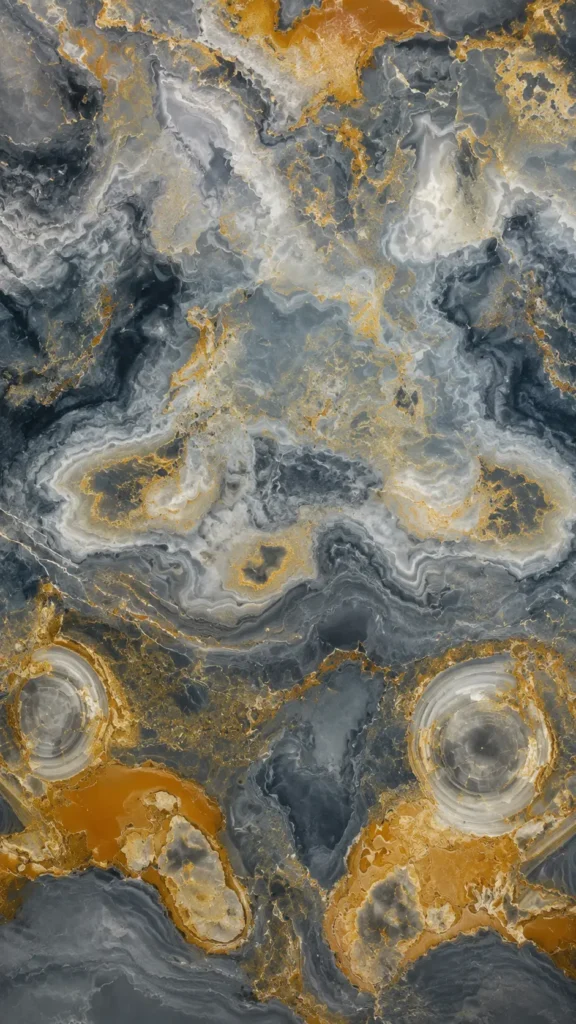
Irani Blue Onyx (also called Iranian Blue Onyx) is a rare, cool-toned variety of natural onyx a banded calcite formed through mineral deposition in ancient cave and spring systems, the same slow geological process that gives all onyx its defining superpower: translucency. Light passes through a correctly cut slab of this stone, and because Irani Blue Onyx forms with such a distinct, layered mineral history, the effect under backlighting is unlike almost anything else in natural stone.
Its base tone runs through cool charcoal, smoke-grey, and soft steel-blue fields, threaded with bold, molten-looking gold and amber veining that traces across the surface like lightning caught mid-strike. Scattered through many lots are striking circular, geode-like formations concentric rings of pale stone ringed in gold, almost resembling a cross-section of an agate or a slow-motion whirlpool frozen in rock. No two slabs repeat this pattern the same way. Every single one is a one-off composition, which is precisely why this stone reads less like flooring and more like a commissioned art piece.
How Irani Blue Onyx Actually Forms — And Why That Explains Its Pattern
Understanding the geology behind this material isn’t just trivia it explains exactly why the stone looks the way it does, and why buyers should treat every slab as a unique piece rather than a repeatable product.
Onyx in general forms through mineral-rich water depositing layer after layer of calcite inside underground caverns and spring systems over long periods of time the same slow process that creates stalactites and stalagmites, just compressed into a solid, cuttable formation instead. The banding you see in any onyx slab is essentially a timeline: each layer represents a distinct phase of mineral deposition, shaped by shifts in water chemistry, temperature, and the surrounding rock.
Irani Blue Onyx forms in deposits where cooler, iron-poor mineral water created the dominant charcoal and steel-grey base layers, while separate, iron-rich mineral flows later intruded through cracks and fault lines in the existing formation depositing the bold gold and amber veining as a second, distinct geological event layered on top of the first. The circular geode-like formations occur where mineral-rich water pooled and crystallized around a central point rather than flowing in a single direction, creating those unmistakable concentric rings.
Because this is the result of at least two separate mineral events intersecting inside the same rock, no formula or pattern predicts exactly how a given block will look once it’s cut open. That’s the entire reason this stone commands the attention and the price that it does.
7 Breathtaking Reasons Irani Blue Onyx Is Pakistan’s Most In Demand Feature Stone Right Now
1. Genuine Rarity, Not Marketing Rarity
A lot of “rare” stone marketing is exaggeration. Irani Blue Onyx is a rare stone in the literal sense cool toned onyx with this specific charcoal and gold geode patterning occurs in limited quarry lots, and availability shifts block by block. When a client wants a material competitors genuinely cannot source elsewhere, this is one of the very few natural stones that can deliver on that promise honestly, rather than simply being marketed as exclusive while remaining widely available through a dozen other suppliers.
2. A Pattern Nothing Else in Natural Stone Replicates
Marble gives you veining. Granite gives you speckling. Even most onyx gives you soft, parallel banding. Irani Blue Onyx gives you all three at once, plus something extra: those unmistakable circular, ringed geode formations that look almost designed, except they’re entirely natural. It’s the single most distinctive visual signature in our entire onyx catalogue, and one of the very few natural stone patterns that regularly gets mistaken, at first glance, for a piece of abstract art rather than a construction material.
3. A Backlit Performance That Feels Alive
Because the stone’s structure combines dense charcoal fields with thinner, more translucent gold-veined zones, backlighting doesn’t just illuminate Irani Blue Onyx evenly — it reveals depth. Light pools more intensely through the pale geode centers and traces along the gold veining, creating a dimensional, almost molten-lava effect rather than a flat glow. This is the reason lighting designers specifically request this stone for hero installations, and why static photography, however good, still consistently undersells how the material performs once it’s actually installed and lit.
4. Unmatched Versatility for Cool, Modern, Editorial Interiors
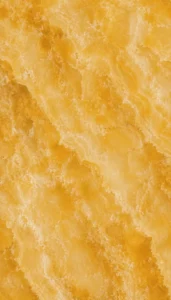
Where warm onyx colours (honey, pink) are built for cozy, inviting spaces, Irani Blue Onyx was practically made for the opposite brief — moody, editorial, contemporary interiors: industrial-luxury hotel lobbies, high-fashion retail flagships, private members’ clubs, executive boardrooms, and residential spaces built around a monochrome, architectural palette. It’s one of the only natural stones that pairs comfortably with both black steel and warm brass without looking out of place next to either.
5. Factory-Direct Value on an Ultra-Premium Material
Rare stone usually comes with rare markups, especially once it passes through two or three trading layers before reaching a buyer. Because Pakistan Marble & Onyx sources, cuts, and finishes this material entirely in-house, we remove those extra layers — meaning you pay for the stone’s genuine rarity, not for a chain of middlemen’s margins stacked on top of it. For a material this visually valuable, that difference in landed cost is rarely small.
6. Slab-by-Slab Quality Control Built for a Demanding Material
A stone this visually complex punishes careless sourcing. A poorly graded slab can hide dead zones with no light transmission, or crack risk right along its most dramatic veining. We inspect every candidate slab individually — for translucency, structural integrity, and finish — before it’s approved for export, so what you see in the photograph is exactly what arrives on site, not a rough approximation of it.
7. Investment-Grade Marketing Value for Hospitality & Retail Brands
In an era where every hotel lobby and retail flagship competes for social media attention, a single Irani Blue Onyx feature wall or bar front routinely becomes the most-photographed spot in the building. Brands increasingly treat this stone as a marketing asset in its own right — a permanent, ownable visual signature that a paid campaign could never replicate, and one that keeps generating organic content long after a launch event has ended.
Irani Blue Onyx vs. Our Other Onyx Colours
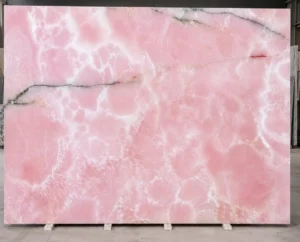
We supply a full range of onyx — green, pink, honey, white, and Irani Blue — and each earns its place for a different design brief.
Green Onyx delivers bold, jewel-toned drama in warm-adjacent settings; Pink and Honey Onyx bring softness and warmth to spas, bars, and residential interiors; White Onyx offers a clean, neutral glow for minimalist spaces. Irani Blue Onyx sits apart from all of them — it’s the only variety in our catalogue built specifically for cool, moody, architectural interiors, and the only one carrying that signature geode-ring patterning. If a project calls for warmth, this isn’t the stone. If it calls for drama with a contemporary, almost geological-art quality, nothing else in our range comes close.
Compared to genuine Blue Onyx (a rarer, more saturated blue-toned variety we also carry in limited lots), Irani Blue Onyx trades pure blue saturation for a broader, more complex charcoal-gold composition — arguably more versatile across a wider range of interior palettes, since it pairs as comfortably with black and brass as it does with grey and chrome. Buyers deciding between the two often choose Irani Blue Onyx specifically because its warm gold veining gives designers more flexibility to bridge cool stone with warmer surrounding materials, something pure Blue Onyx does less naturally.
Irani Blue Onyx vs. Marble, Granite & Quartzite
Vs. Marble. Even the boldest marble — black & gold, for instance — reads as more restrained and monochromatic than Irani Blue Onyx’s multi-tone composition. And marble, however dramatic, never transmits light. Irani Blue Onyx can do both: dramatic surface pattern and genuine backlit glow, which is why the two materials are frequently specified together rather than in competition — marble for flooring and structural surfaces, Irani Blue Onyx for the one feature moment a project is built around.
Vs. Granite. Granite’s strength is durability and consistency — the opposite design decision to what this stone offers. Irani Blue Onyx deliberately trades that predictability for one-of-a-kind visual impact and translucency, and no amount of granite polishing will ever produce genuine light transmission through the stone.
Vs. Quartzite. Some quartzites mimic bold veining, and a handful even approach a similar grey-and-gold palette at a glance. But none replicate real onyx translucency or the layered depth this stone shows once lit from behind. If the brief needs “glows dramatically from within,” quartzite simply cannot compete — it can only imitate the surface pattern in daylight, not the performance under lighting that makes Irani Blue Onyx worth specifying in the first place.
Vs. Engineered Stone & Porcelain Panels. Increasingly, some engineered and printed porcelain panels attempt to reproduce dramatic natural-stone patterns, including grey-and-gold veining. These can be a reasonable budget alternative for large, low-visibility surfaces, but they cannot replicate genuine translucency, the tactile depth of real stone, or the fact that no engineered panel is ever truly one-of-a-kind. For a genuine hero feature — the piece a project is designed around — real Irani Blue Onyx remains in a category of its own.
Why Choose Pakistan Marble & Onyx for Irani Blue Onyx
Factory-direct sourcing and pricing. We control the full chain — quarry sourcing, cutting, polishing — removing the markups that come from third-party stone trading, so buyers pay for genuine rarity rather than a stack of resale margins.
Individual slab photography and selection. Because this material’s entire value is its unrepeatable pattern, we photograph and grade candidate slabs individually so you choose the exact piece for your feature installation, not a random allocation from generic stock.
Backlit-grade quality control across every zone of the slab. We test light transmission across both the charcoal fields and the gold-veined and geode areas, since uneven performance is more visible in a stone this visually complex than in a single-tone onyx.
Custom fabrication. Cut-to-size slabs, tiles, countertops, bar fronts, tabletops, and bespoke fixtures, built to your exact architectural drawings rather than generic catalog dimensions.
Full export management. Documentation, container loading, and worldwide shipping logistics handled end-to-end, so you can order with confidence regardless of destination country.
A single, direct point of contact. You deal with our export team throughout — never a broker relaying messages back and forth, which matters enormously on a material where slab selection is a collaborative, photography-led process rather than a simple order form.
Consultative sourcing rather than catalogue selling. Because no two slabs are alike, we treat every serious Irani Blue Onyx inquiry as a conversation about the specific project — its lighting plan, its surrounding materials, its intended mood — rather than a transaction against a fixed product listing.
Irani Blue Onyx Products We Supply
- Irani Blue Onyx Slabs — polished or backlit-grade, sold individually selected or as bookmatched pairs
- Irani Blue Onyx Blocks — for fabricators and processors running their own cutting operations
- Irani Blue Onyx Tiles — for accent flooring and wall applications
- Irani Blue Onyx Countertops & Vanity Tops — for bathrooms, bars, and hospitality fit-outs
- Irani Blue Onyx Bar Fronts & Reception Desks — selected specifically for maximum backlit and visual impact
- Irani Blue Onyx Tabletops & Coffee Tables — statement furniture pieces for residential and hospitality interiors
- Irani Blue Onyx Wall Panels — for hero feature walls, backlit or naturally lit
- Irani Blue Onyx Sinks & Basins — for luxury bathroom and powder room installations
- Custom Irani Blue Onyx Fixtures — sinks, panels, and bespoke pieces to architectural specification
Many buyers order a single hero slab of Irani Blue Onyx for one signature application — a reception desk, a bar front, an entryway panel — and pair it with quieter, neutral surrounding materials so the feature stone remains the undivided focal point. Others, particularly larger hospitality projects, commission a coordinated set of pieces — a bar front, matching side panels, and a smaller tabletop or two — cut from adjacent slabs of the same block so the pattern flows as one continuous composition across multiple surfaces.
Where Irani Blue Onyx Is Most Requested
Luxury hotel lobbies & reception desks. A backlit Irani Blue Onyx reception desk turns arrival into an event — the kind of first impression five-star properties specifically brief for when they want a lobby moment guests photograph before they’ve even checked in.
High-fashion & flagship retail. Feature counters and wall panels in fashion, jewellery, and cosmetics flagships use this stone as a genuine visual anchor that photographs as well in a magazine spread as it does in person, reinforcing a brand’s premium positioning without a single word of copy.
Private members’ clubs & executive lounges. The cool, moody palette suits the exclusive, editorial tone these spaces are built around, where warmth would feel too casual for the brief.
Boardrooms & corporate reception. A single Irani Blue Onyx feature wall increasingly replaces commissioned art in corporate lobbies wanting a memorable, architecturally serious first impression that signals scale and permanence.
Contemporary residential interiors. Backlit entryway walls, home bar backdrops, and statement powder rooms for clients building around a monochrome, industrial-luxury palette rather than a traditional warm-toned home.
Restaurants & lounges with an “elemental” design concept. The stone’s geological, almost volcanic look fits concepts leaning into raw, natural material storytelling — exposed stone, unfinished metal, and dramatic lighting rather than a soft, upholstered aesthetic.
Spa environments with a “cosmic” or “elemental” theme. A newer application: some wellness brands are specifying Irani Blue Onyx specifically for its otherworldly, almost cosmic appearance in meditation and treatment spaces built around a more mysterious, less conventionally “soft” wellness aesthetic.
Museum, gallery & cultural institution interiors. Given how naturally the stone resembles abstract art, several cultural and gallery spaces have specified it deliberately as a bridge between architecture and the artwork it surrounds.
Finishes We Offer for Irani Blue Onyx
- Polished Irani Blue Onyx — maximises contrast and depth between the charcoal fields and gold veining, the most requested finish for feature applications
- Honed Irani Blue Onyx — a matte, softer surface, sometimes chosen for tabletop or countertop use where glare needs to be minimised
- Backlit-Grade Irani Blue Onyx — individually tested for even light transmission across all zones of the slab, specifically graded for lit installations
- Bookmatched Irani Blue Onyx — mirrored slab pairs from the same block, letting the geode patterning form a large, symmetrical composition across a bigger wall or bar front
Understanding the Pattern: Fields, Veining & Geode Rings
Charcoal and steel-grey fields form the dominant base tone across most lots, ranging from deep smoke-grey to a lighter, softer steel-blue, and generally make up the largest visual area of any given slab.
Molten gold and amber veining traces through the grey fields where mineral-rich deposits intersected the formation — the boldest, most photographed feature of the stone, and typically the first thing a viewer’s eye is drawn to.
Geode-like circular formations — concentric rings of pale stone bordered in gold — appear scattered through certain lots, resembling a cross-section of agate or a captured whirlpool. These are the rarest and most requested feature within the stone, and slabs carrying multiple clear geode rings command the highest interest for hero applications, often becoming the deciding factor in which specific slab a client ultimately selects.
Transitional zones, where the grey fields meet gold veining or geode boundaries, often show the finest, most delicate detail in the stone — faint secondary veining and subtle colour gradients that are easy to miss in a small sample but become a defining feature once a slab is installed at full scale under proper lighting.
Because this composition is entirely natural and never repeats, we strongly recommend requesting photography of actual candidate slabs before committing to a feature installation — a generic description simply cannot convey which specific piece will anchor your space, and the difference between a “good” slab and an exceptional one for this material is almost entirely about pattern, not colour category.
How We Quality-Check Every Irani Blue Onyx Slab
Translucency across every zone. Charcoal fields, gold veining, and geode centers can transmit light differently within the same slab; we test backlit performance across the whole surface, not a single point, to catch any dead zones before they become a problem on site.
Structural integrity around veining and geode boundaries. The transition lines between colour zones and around geode rings can represent natural weak points; we inspect these carefully before approving export, since a crack along a dramatic vein line is both more likely and more visually damaging than a crack in a plain field.
Finish accuracy. Polished and honed finishes are checked for even application across both the grey fields and gold-veined areas, since these different mineral compositions can occasionally respond slightly differently during polishing.
Individual documentation. Every candidate slab we offer for feature use is photographed individually, since no written grade or category can substitute for seeing the actual piece — a “grade A” label means very little on a material where the whole point is pattern uniqueness.
Colour and pattern grading. We sort available slabs loosely by pattern intensity — from subtler, more restrained charcoal-and-gold pieces to bold, multi-geode showpieces — so buyers can quickly narrow toward the visual intensity that matches their project rather than reviewing every available slab from scratch.
Sourcing & Processing: From Quarry to Your Project
- Sourcing — Blocks are selected directly from partner quarries known for producing this specific charcoal-gold-geode formation, inspected on-site for grain structure and crack risk before purchase.
- Processing — Blocks are cut into slabs at our factory, with polishing or honing applied per project requirement.
- Quality Inspection — Every slab checked for translucency, structural soundness, and finish accuracy as detailed above.
- Individual Slab Photography — Candidate slabs are photographed so buyers can select the specific piece for their feature application.
- Custom Fabrication — Cut-to-size and finished-product fabrication completed to architectural drawings where provided.
- Packing & Crating — Export-standard packing designed to prevent breakage and moisture damage on long sea freight journeys.
- Export & Logistics — Full documentation, container loading, and freight coordination through to your destination port.
Because this material is naturally more structurally variable than single-tone onyx, our processing team pays particular attention to cutting angle and blade speed around veining and geode boundaries, reducing the risk of the micro-fractures that can develop if a visually complex slab is rushed through standard equipment settings designed for more uniform stone.
Sizes, Thicknesses & Container Planning
Slab sizes. Irani Blue Onyx is typically supplied as full-slab pieces to preserve the natural composition intact, since cutting down a slab can remove the very pattern that made it striking. Custom sizing is available where a project genuinely requires it, though we always flag if a requested cut would compromise a slab’s most striking features.
Thicknesses. Backlit applications generally call for a thinner slab to maximise light transmission through the denser charcoal zones; our team advises on the ideal thickness once we understand your lighting design, since geode centers and gold veining zones often transmit light differently than the surrounding grey field even at the same thickness.
Block dimensions. Fabricators who prefer to select and cut their own material can receive photography of cut block faces to assess pattern and colour zoning before purchase, rather than buying blind against a generic description.
Container capacity. Because this stone is most often ordered as individually selected hero pieces rather than large uniform volumes, our logistics team advises on the most efficient way to crate and ship a smaller number of high-value slabs, often consolidated with other materials in the same container to optimise freight cost.
Pricing & Wholesale Supply
Irani Blue Onyx pricing is driven primarily by the visual quality and rarity of each slab’s specific pattern — particularly the presence, clarity, and number of geode-ring formations — alongside standard factors like size, thickness, and finish. Slabs with a striking, well-balanced distribution of charcoal, gold veining, and multiple clean geode rings command a genuine premium over more subtly patterned pieces, in much the same way a particularly striking cut of any rare gemstone commands more than a plainer one of the same species.
Because this is a slab-selected material, our export team typically quotes on a piece-by-piece basis for feature applications, with standard per-square-metre pricing for buyers ordering larger volume for tiles or less visually critical uses. Distributors interested in carrying Irani Blue Onyx as a premium addition to their onyx line are welcome to discuss ongoing photography-led selection arrangements, where we forward newly graded slabs as they become available so a distributor can offer their own clients first choice on genuinely limited material.
For architects working through early budgeting stages, we’re glad to provide indicative pricing ranges across different pattern-intensity tiers, so a rough feature-wall budget can be set before a final slab is chosen.
Shipping Irani Blue Onyx: Regional Notes
Middle East & Gulf. Strong demand for hero feature slabs in five-star hotels, private clubs, and luxury villa projects, where an unrepeatable slab is a deliberate brand-differentiation choice. We structure logistics for fast turnaround given the pace of luxury construction in this region.
Europe. Designers frequently request this material for boutique hospitality and editorial residential feature walls, often working closely through our sample and slab-selection process over several rounds of photography before a final decision.
North America. Distributors and fabricators increasingly carry Irani Blue Onyx as a premium, statement-tier addition to their onyx catalogue, often marketed as a limited or rotating selection given the material’s naturally restricted supply.
Asia & Southeast Asia. Rising interest from boutique hotel and luxury retail developments wanting a genuinely one-of-a-kind feature material to differentiate from competitors using more common onyx colours.
Africa. An emerging market for luxury hospitality and residential feature installations as high-end construction activity expands across the continent.
Regardless of destination, our team manages documentation, customs paperwork, and shipping coordination for these often high-value, individually selected shipments, including any additional insurance or crating considerations that come with shipping a genuinely irreplaceable slab.
Design Trends Around Irani Blue Onyx
The “single hero slab” approach. Rather than covering an entire wall, more designers use one dramatic Irani Blue Onyx slab as a contained feature — a bar front, a reception desk face, a single backlit panel — letting its natural complexity carry the room without overwhelming it.
Bookmatched compositions. Where slab availability allows, mirroring two adjacent slabs from the same block creates a large-format, symmetrical “captured storm” effect increasingly used as a lobby or bar centerpiece, and is often the single most requested configuration for large hospitality budgets.
Monochrome and black-and-brass pairings. Matte black steel, brushed brass, and unadorned plaster are the most common surrounding materials, keeping the stone as the undisputed focal point rather than competing with busier surrounding finishes.
Positioned as art, not material. More installations now present this stone explicitly as a natural art piece — sometimes even framed or lit like a gallery installation — reflecting how design-forward hospitality and retail brands are treating it as a marketing asset in its own right, not simply a surface finish.
Dramatic uplighting and edge-lighting techniques. Beyond simple flat backlighting, some of the most striking recent installations use angled uplighting from the base of a panel, which interacts with the geode rings and veining to create shifting shadow and light effects throughout the day and evening.
Pairing with water features. A newer trend in spa and wellness settings pairs Irani Blue Onyx feature walls with thin sheets of falling water directly in front of the lit stone, exaggerating the “frozen storm” visual effect the material is already known for.
Care & Maintenance
Irani Blue Onyx is a calcium-based, relatively soft and porous stone, and needs a slightly different care approach than harder surfaces:
- Use pH-neutral stone cleaners only; acidic products can etch the surface and dull the polish, particularly across the more delicate gold-veined zones.
- Seal polished surfaces periodically, particularly on countertops, bar tops, and vanity applications, to guard against staining from liquids and oils.
- Avoid prolonged direct moisture contact without sealing, given the stone’s natural porosity.
- For backlit installations, install consistent lighting across the full panel — uneven sources can distort the natural balance between the charcoal fields, gold veining, and geode centers, undermining the exact effect the material was chosen for.
- Avoid heavy-traffic flooring or high-impact surfaces; this stone performs best in the feature and accent applications it’s typically specified for.
- For pieces with pronounced geode rings, periodic gentle buffing with a stone-safe polish helps maintain the contrast between the ring’s pale center and its gold border over time.
We’re glad to provide more detailed, material-specific maintenance documentation for architects and designers to pass along to end clients or facilities teams.
Sustainability & Responsible Sourcing
Quarrying Irani Blue Onyx, like all natural stone, draws on a non-renewable resource, and we take that responsibility seriously. Because this material is often sold as individually selected hero slabs, we work to maximise the usable yield of visually striking pieces from each block, redirecting less dramatic sections into tiles or smaller finished products rather than discarding them. We work only with quarry partners operating under recognised mining regulations, and continue to refine our cutting process specifically for this material to reduce waste around its more structurally delicate veining and geode zones.
Working With Us Long-Term
Because Irani Blue Onyx is selected slab by slab rather than ordered as a uniform bulk product, our relationship with buyers on this material tends to be consultative — reviewing photography together, discussing which slab suits a specific feature application, and planning around genuine quarry availability. Architects and designers working on hospitality or high-end residential projects are welcome to reach out early in the design process, even before material budgets are finalised, so we can flag suitable slabs as they become available.
Distributors interested in carrying this stone as an ongoing premium offering can discuss a standing arrangement where we forward photography of newly available hero slabs as they’re cut and graded, letting them offer genuinely limited material to their own client base ahead of general availability.
How to Order Irani Blue Onyx From Us
- Send your inquiry — share your intended application (bar front, feature wall, tabletop, etc.), approximate size needed, and destination country.
- Review slab photography — we send photography of currently available Irani Blue Onyx slabs matching your requirement so you can select the exact piece.
- Confirm your order — once you’ve chosen a slab and approved pricing, we confirm any custom fabrication requirements.
- Production & quality check — your slab moves through cutting, polishing, and inspection, with final photography provided before packing.
- Export & delivery — we handle documentation, container loading, and shipping coordination through to your destination port.
Throughout the process, you work with the same export contact rather than being passed between departments — particularly valuable on a material where ongoing photography and back-and-forth on slab selection is part of getting the order right.
Frequently Asked Questions About Irani Blue Onyx
What makes Irani Blue Onyx different from other onyx colours? It’s the only variety in our range built around a cool charcoal-grey base combined with bold gold veining and rare geode-like circular formations — a completely different visual language from warm onyx colours or standard green onyx.
Is Irani Blue Onyx suitable for backlit installations? Yes — it’s specifically prized for backlit use, since the charcoal fields, gold veining, and geode centers transmit light differently, creating a dimensional glow rather than a flat one.
Can I choose the exact slab I’m ordering? Yes, and we recommend it. Because every slab has a unique pattern, we provide photography of available pieces so you can select the specific slab for your project.
Can Irani Blue Onyx be bookmatched? Yes, where two adjacent slabs from the same block are available, we can supply them as a bookmatched pair for a larger, symmetrical feature composition.
Is this stone suitable for countertops? It can be used for countertops and tabletops, though as a softer, more porous stone, it’s best suited to lower-traffic surfaces rather than heavy-use kitchen prep areas — proper sealing is recommended.
Do you supply Irani Blue Onyx in bulk quantities? It’s most commonly supplied as individually selected slabs rather than large uniform volumes, given its naturally variable pattern, though we can source multiple slabs for larger feature installations or distributor programs.
How is Irani Blue Onyx priced compared to other onyx? Pricing depends heavily on a slab’s specific pattern quality — particularly the presence and clarity of geode-ring formations — and typically commands a premium over more standard single-tone onyx.
Do you export Irani Blue Onyx worldwide? Yes, we export slabs and finished products to buyers across the Middle East, Europe, North America, Asia, and Africa, with full documentation and shipping support.
What lead time should I expect? Lead time depends on the availability of suitable slabs matching your project’s requirements; our team can advise on current availability and realistic timelines once we understand your project.
Can I combine Irani Blue Onyx with other stone in the same project? Yes — many buyers pair a single hero slab with a more uniform material like marble, travertine, or a single-tone onyx for surrounding surfaces, so the feature slab remains the clear centerpiece.
Is Irani Blue Onyx genuinely rare, or is that just a sales term? Genuinely rare — the specific combination of cool charcoal tone, gold veining, and geode-ring patterning occurs in limited quarry lots, and availability shifts from block to block rather than being a constant, mass-producible supply.
How do the geode-like circles actually form? They form where mineral-rich water pooled and crystallised around a central point during the stone’s formation, rather than flowing in a single direction the way most onyx banding does — creating concentric rings instead of parallel bands.
Does every slab of Irani Blue Onyx have geode rings? No — geode-ring formations appear in some lots and not others, which is exactly why slabs carrying multiple clear, well-defined rings tend to command the strongest interest and highest pricing within this material.
What’s the difference between Irani Blue Onyx and true Blue Onyx? True Blue Onyx carries a more saturated, uniform blue tone and is rarer still. Irani Blue Onyx offers a broader charcoal-and-gold composition that many designers find more versatile to work into a wider range of interior palettes.
Can this stone be used outdoors? No — like other onyx varieties, Irani Blue Onyx is best reserved for interior or fully covered applications, given its sensitivity to prolonged weather exposure compared to more durable exterior materials like travertine or sandstone.
Ready to see available Irani Blue Onyx slabs for your project? Contact us with your application and destination country, and our export team will send current slab photography, pricing, and lead times.